Postpartum Hair Loss: It’s Not Just You, and It’s Not Just Hair

If you’ve ever stood in the shower postpartum, staring at a handful of hair and wondering “Is this normal… or is something wrong with me?”, you’re not alone. And no, this isn’t just another blog telling you to “reduce stress” or “switch to sulphate-free shampoo.”

Let’s be honest: most postpartum hair advice feels disconnected from real life.
This is a different conversation, one about listening to your body, not fighting it.
First: Let’s Normalize Postpartum Hair Loss (Without Minimizing It)
Yes, postpartum hair shedding is common.
And yes, hormones play a role.
During pregnancy, higher estrogen levels keep hair in the growth phase longer, which is why so many people notice thicker hair. After birth, estrogen drops — and the hair that would have shed gradually sheds all at once instead.
That’s the science.
But here’s the part that often gets skipped:
Your hair loss isn’t just hormonal — it’s contextual.
It’s happening while you’re:
Sleep‑deprived
Nutrient‑depleted
Emotionally stretched
Recovering physically
Learning a whole new version of yourself
So when we reduce postpartum hair loss to “don’t worry, it’s normal”, we miss the bigger picture.
Hair Loss as Information, Not a Problem to Fix
I like to think of hair changes the same way I think about stress (because they’re often connected):
They’re communication, not malfunction.
Your body isn’t betraying you — it’s talking to you.
Sometimes it’s saying:
“I’m low on iron.”
“I haven’t had consistent nourishment in a while.”
“I’m running on empty.”
“Something is shifting hormonally again” (hello, perimenopause 👋).
For me, staying in tune with my body has been everything.
I’ve had periods where my hair felt thin, dull, or just… not mine. And over time, I learned that when my hair changed, something underneath needed attention, not panic.
Nutrition: Let’s Be Real About It
Here’s where I want to be very clear and very honest.
Not everyone can “just eat better.”
I live with ARFID, which means my eating habits don’t look like a wellness influencer’s grocery haul. I can’t simply add more leafy greens or magically hit all my nutrient needs through food alone.
And you know what?
That doesn’t make me irresponsible or disconnected from my body.
For me, a solid supplement foundation has been essential, not as a shortcut, but as an accommodation. It’s how I stay regulated, nourished, and able to respond when my body asks for more (or less) of something.
That foundation is also what allowed my hair to:
Recover postpartum
“Get back to normal”
Adjust again now as I navigate perimenopause
The key isn’t perfection — it’s responsiveness.
Supplements, Adjustments, and Ongoing Check‑Ins

Postpartum hair health isn’t about taking everything.
It’s about having a baseline and adjusting as your body changes.
Things that often matter postpartum:
Iron (especially if you had blood loss or long labour)
Vitamin D
B‑complex vitamins
Protein intake (however that works for you)
Omega‑3s
Bone broth (my personal suggestion for ALL of life's journeys!)
This doesn’t mean everyone needs supplements; it means some bodies do, and that’s okay.
Your needs postpartum may not be the same:
3 months later
After weaning
As sleep changes
As hormones shift again later in life
Hair responds slowly, which is why consistency matters more than quick fixes.
Hair Care Isn’t the Star of the Show (But It Still Matters)
Yes, gentle hair care helps, but it’s supporting, not leading.
Things that can reduce breakage and stress on already‑shedding hair:
Gentler brushing
Avoiding tight hairstyles
Less heat and chemical processing
Scalp massage, if it feels good to you
Notice the theme?
If it feels good to you.
Not everyone finds scalp massage relaxing.
Not everyone wants oils.
Not everyone enjoys long routines.
That’s okay.
Stress, Nervous System, and Hair (Without the “Just Relax” Trap)
We can’t talk about postpartum hair without acknowledging stress, but not in the lazy, clinical way it’s usually done.
Stress isn’t something you simply remove.
It’s something you carry differently depending on your nervous system, support, history, and capacity.
Hair follicles are sensitive to prolonged stress signals, not because you’re doing something wrong, but because the body prioritizes survival over aesthetics.
So instead of asking:
“How do I eliminate stress?”
Try asking:
“What helps my body feel a little safer, a little more resourced?”
That answer will look different for everyone, and it might change over time.
Does Cutting Your Hair Help? Let’s Clear That Up
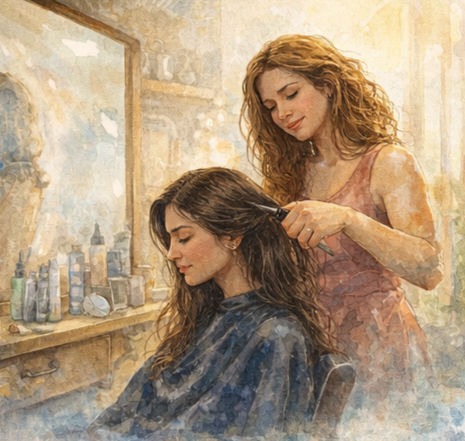
Cutting your hair won’t stop postpartum shedding, because the shedding starts at the root.
But it can help with:
Tangling
Breakage
The emotional weight of seeing long strands fall out
Feeling more like yourself again
If cutting your hair feels empowering, grounding, or relieving, that matters.
If it doesn’t?
You’re not doing anything wrong by keeping it long.
When to Look Deeper
If hair loss feels extreme, prolonged, or paired with:
Fatigue
Mood changes
Cold intolerance
Cycle changes
Anxiety that feels unmanageable
…it’s worth checking in with a healthcare provider to rule out things like thyroid changes or significant nutrient depletion.
This isn’t about fear — it’s about informed care.
A Gentler Reframe
Postpartum hair loss isn’t a failure.
It’s not vanity.
And it’s not something to rush through.
It’s one of the many ways your body says:
“A lot has happened. Please notice me.”
You don’t need another rigid routine.
You don’t need to “fix” yourself.
You need support that fits your actual life — your nervous system, your eating patterns, your stage of life, and your capacity.
And that deserves more than black‑and‑white advice.
If you’re navigating postpartum changes, whether hair, hormones, or identity shifts, you don’t have to figure it all out alone. Your body is telling a story, and it deserves to be heard, not rushed or fixed.
Let’s talk.
Book a free 20‑minute connection call with me to explore your hair, hormones, and whole‑body experiences holistically, no judgment, just curiosity and support.
Whether it’s postpartum recovery, perimenopause shifts, supplement routines that actually work for you, or simply a body that feels like it’s constantly changing — I’m here to help you translate the signals and find what feels right.


Comments